
People in Bitcoin
Bitcoin didn't emerge from a vacuum. It was built on decades of cryptographic research and the work of visionary cypherpunks who dreamed of digital cash. This page honors both the pioneers who laid the groundwork and the contributors who brought Bitcoin to life.
Pioneers (pre-Bitcoin): David Chaum, Eric Hughes, Timothy C. May, John Gilmore, Adam Back, Nick Szabo, Wei Dai, Ralph Merkle, Stuart Haber and Scott Stornetta
Bitcoin builders: Satoshi Nakamoto, Hal Finney, Len Sassaman, Martti Malmi, Gavin Andresen, Laszlo Hanyecz, Wladimir van der Laan, Pieter Wuille, Gregory Maxwell, Joseph Poon and Thaddeus Dryja
Evangelists & beyond: Andreas M. Antonopoulos, Roger Ver, You ?
David Chaum
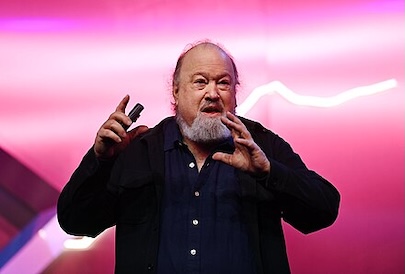
Contribution: eCash (1982) - The godfather of cryptocurrency
David Chaum is widely regarded as the inventor of digital cash. In 1982, he published "Blind Signatures for Untraceable Payments," introducing the concept of cryptographically secure anonymous payments. His company DigiCash launched eCash in the 1990s, which allowed users to withdraw digital tokens from a bank and spend them anonymously.
While eCash ultimately failed commercially (DigiCash went bankrupt in 1998), Chaum's work established the fundamental cryptographic techniques for digital currency, including blind signatures that preserve privacy. His vision of electronic cash that could replicate the anonymity of physical cash directly inspired the cypherpunk movement and later cryptocurrency development.
Eric Hughes
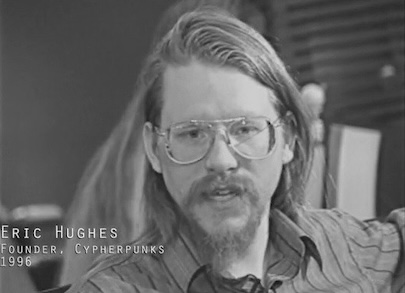
Contribution: "A Cypherpunk's Manifesto" (1993) - Privacy through cryptography
Eric Hughes is a mathematician and privacy advocate who wrote "A Cypherpunk's Manifesto" in 1993, which became one of the foundational documents of the cypherpunk movement. The manifesto articulated that privacy in an open society requires cryptography, not laws or the good intentions of institutions. Along with Timothy C. May and John Gilmore, Hughes co-founded the legendary cypherpunk mailing list where the ideas that would eventually produce Bitcoin were debated and refined.
The manifesto's principles, that we must defend our own privacy, that cryptography enables anonymous systems, and that we cannot expect governments or corporations to grant privacy, directly shaped the worldview behind Bitcoin. The cypherpunk culture of building tools rather than petitioning authorities found its fullest expression in Satoshi's creation of a peer-to-peer electronic cash system that required no one's permission.
Timothy C. May

Contribution: "The Crypto Anarchist Manifesto," cypherpunk mailing list co-founder
Timothy C. May was an American physicist and writer who authored "The Crypto Anarchist Manifesto" (1988) and co-founded the cypherpunk mailing list with Eric Hughes and John Gilmore in 1992. His manifesto envisioned a future where cryptography would enable anonymous markets and transactions beyond the reach of governments, laying the ideological groundwork for digital cash and permissionless systems.
May's writings foresaw many developments: anonymous digital currencies, reputational systems beyond national borders, and the collision of technology with traditional notions of regulation. The cypherpunk mailing list he helped create became the incubator where Chaum's eCash, Back's Hashcash, and Szabo's Bit Gold were discussed; the same community where Satoshi Nakamoto would later announce Bitcoin. May passed away in 2018.
John Gilmore
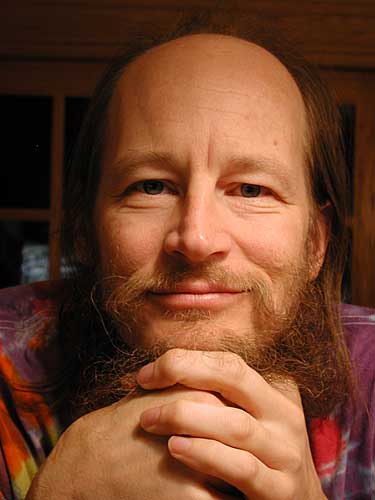
Contribution: Cypherpunk mailing list co-founder (1992)
John Gilmore is a computer scientist, entrepreneur, and civil-liberties advocate who co-founded the cypherpunk mailing list with Eric Hughes and Timothy C. May in 1992. The list became the main forum where ideas that would eventually produce Bitcoin, including David Chaum's eCash, Adam Back's Hashcash, and Nick Szabo's Bit Gold, were debated. Gilmore also co-founded the Electronic Frontier Foundation (EFF) and Cygnus Solutions; his work on open systems and crypto advocacy helped create the culture in which Satoshi Nakamoto would later publish the Bitcoin whitepaper.
Adam Back

Contribution: Hashcash (1997) - Proof-of-Work for spam prevention
Adam Back is a British cryptographer who invented Hashcash in 1997, a proof-of-work system designed to limit email spam and denial-of-service attacks. The core idea was elegant: require senders to perform computational work before sending an email, making mass spam economically infeasible.
Hashcash's proof-of-work mechanism became a critical component of Bitcoin. Satoshi Nakamoto cited Hashcash in the Bitcoin whitepaper, and Bitcoin's mining algorithm is essentially Hashcash applied to transaction validation. Back is one of only two people cited in the Bitcoin whitepaper who are still alive (the other being Wei Dai).
Back is currently CEO of Blockstream, a Bitcoin infrastructure company he co-founded in 2014.
Nick Szabo

Contribution: Bit Gold (1998) - Decentralized digital currency concept
Nick Szabo is a computer scientist, legal scholar, and cryptographer who designed Bit Gold in 1998, often called the direct precursor to Bitcoin. Bit Gold proposed a decentralized digital currency where participants would use computational power to solve cryptographic puzzles, with solutions timestamped and published to a distributed registry.
Szabo also coined the term "smart contracts" in 1994, describing self-executing contracts with terms written directly into code, a concept that would later become central to Ethereum and other blockchain platforms.
The similarities between Bit Gold and Bitcoin are so striking that many have speculated Szabo is Satoshi Nakamoto, which he has denied. Regardless, his intellectual contributions to the conceptual foundations of cryptocurrency are undeniable.
Wei Dai

Contribution: b-money (1998) - Digital scarcity and distributed consensus
Wei Dai is a computer engineer and cryptographer who proposed b-money in 1998, a theoretical system for an anonymous, distributed electronic cash system. His proposal described two protocols: one where all participants maintain a database of account balances, and another using a subset of participants (similar to modern proof-of-stake).
B-money introduced key concepts that would appear in Bitcoin, including:
- The creation of money through computational work
- Verification of work by the community
- A distributed database of transactions
- Transfer of money by signing messages
Satoshi Nakamoto cited b-money in the Bitcoin whitepaper and personally emailed Wei Dai before Bitcoin's launch. Dai has noted that Bitcoin's implementation differs from b-money, particularly in how Nakamoto elegantly solved the double-spending problem with the blockchain.
The smallest subunit of Ether (Ethereum's currency) is called a "wei" in his honor.
Ralph Merkle

Contribution: Merkle trees (1979) - Efficient verification of block contents
Ralph Merkle is a computer scientist who invented Merkle trees (also called hash trees) in 1979. In this structure, leaf nodes contain hashes of data, and each parent node is the hash of its children, building up to a single root hash. The Bitcoin whitepaper uses this construction to enable compact proofs: SPV clients can verify that a transaction is in a block by checking a path from the transaction to the Merkle root in the block header, without downloading the full block.
Merkle trees are fundamental to Bitcoin's block structure. Every block header includes a Merkle root that commits to all transactions in the block; tampering with any transaction changes the root and breaks the chain. Merkle also contributed to public-key cryptography (Merkle's puzzles) and later to nanotechnology. His 1979 paper "Protocols for Public Key Cryptosystems" and the Merkle tree concept are among the cryptographic foundations Satoshi drew on.
Stuart Haber and Scott Stornetta

Contribution: Secure timestamps (1990-91) - "How to time-stamp a digital document"
Stuart Haber and W. Scott Stornetta are cryptographers who, in a 1991 paper, solved the problem of timestamping digital documents so that they cannot be backdated or tampered with. Their scheme linked each new timestamp to the previous one in a chain, creating a cryptographically secured sequence that could prove the order and existence of records. Satoshi Nakamoto cited their work in the Bitcoin whitepaper as a direct precursor to the blockchain's design.
Their approach used hash pointers to create an append-only, tamper-evident log. This "chain of timestamps" is the conceptual ancestor of Bitcoin's blockchain: each block references the previous block's hash, and changing history would require redoing an exponentially growing amount of work. Haber and Stornetta's 1990 paper "How to Time-Stamp a Digital Document" and its 1991 follow-up established the core idea that Bitcoin would combine with proof-of-work and digital cash.
Satoshi Nakamoto
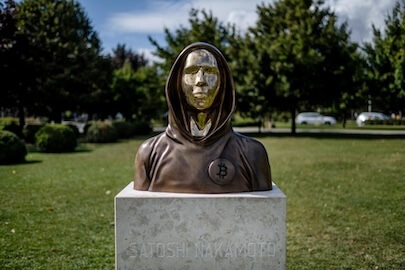
Contribution: Bitcoin (2008-2010) - Creator of Bitcoin
Satoshi Nakamoto is the pseudonymous person or group who created Bitcoin. On October 31, 2008, Nakamoto published the Bitcoin whitepaper, "Bitcoin: A Peer-to-Peer Electronic Cash System." On January 3, 2009, they mined the Genesis Block, embedding the message: "The Times 03/Jan/2009 Chancellor on brink of second bailout for banks."
Satoshi was active in developing Bitcoin and communicating on forums until December 2010, when they handed over control to Gavin Andresen and disappeared. Their last known communication was an email in April 2011.
Key facts about Satoshi:
- Mined an estimated 1 million BTC in early blocks (never moved)
- True identity remains unknown
- Communicated only through forums, emails, and code
- Disappeared without cashing out or claiming credit
The mystery of Satoshi's identity has become part of Bitcoin's mythos. Various candidates have been proposed, including Nick Szabo, Hal Finney, and others, but none have been confirmed. In 2024, a UK court definitively ruled that Craig Wright is not Satoshi Nakamoto.
Hal Finney

Contribution: RPOW, PGP 2.0, first Bitcoin transaction recipient
Hal Finney was a cryptographic pioneer and one of Bitcoin's most important early contributors. Before Bitcoin, he developed RPOW (Reusable Proofs of Work) in 2004, a system that allowed proof-of-work tokens to be reused as digital cash, building on Adam Back's Hashcash. He was also the lead developer of PGP 2.0 (Pretty Good Privacy), the first widely-used implementation of public key cryptography for email encryption.
Finney was the first person other than Satoshi to run the Bitcoin software, and on January 12, 2009, he received the first Bitcoin transaction: 10 BTC from Satoshi Nakamoto. He immediately began contributing to the codebase, reporting bugs and suggesting improvements. He famously tweeted "Running bitcoin" on January 10, 2009.
Interestingly, Finney lived just a few blocks from Dorian Satoshi Nakamoto in Temple City, California, a coincidence that fueled speculation when Dorian was mistakenly identified as Bitcoin's creator by Newsweek in 2014.
Finney was diagnosed with ALS (Lou Gehrig's disease) in 2009 and continued contributing to Bitcoin until his physical limitations made it impossible. He passed away on August 28, 2014, and was cryopreserved by the Alcor Life Extension Foundation.
The "Finney attack" in Bitcoin is named after him: a type of double-spend attack he described where a miner pre-mines a transaction and quickly broadcasts a conflicting one.
Len Sassaman

Contribution: Cypherpunk, anonymous remailer developer
Len Sassaman was a cypherpunk, privacy advocate, and cryptographer who made significant contributions to anonymity and privacy-preserving technologies. He was a core developer of Mixmaster, the most widely-used anonymous remailer protocol, and worked on various cryptographic privacy tools.
Sassaman was embedded in the cypherpunk community that would give rise to Bitcoin. He studied under David Chaum and worked with Hal Finney on PGP-related projects. His work on anonymous communication systems directly relates to Bitcoin's privacy goals.
Tragically, Sassaman died by suicide on July 3, 2011, just as Bitcoin was gaining mainstream attention. A tribute was encoded into the Bitcoin blockchain at block 138725.
Some have speculated that Sassaman was involved in Bitcoin's creation due to his technical skills, cypherpunk connections, and the timing of his death relative to Satoshi's disappearance, though there is no concrete evidence.
Martti Malmi

Contribution: Early contributor (2009-11) - bitcoin.org, first exchange and community tools
Martti Malmi (known online as Sirius) was one of Bitcoin's first contributors after Satoshi Nakamoto and Hal Finney. He began collaborating with Satoshi in 2009, helping to run and design bitcoin.org, implement an early, simple exchange, and build the first Bitcoin forum. Malmi wrote much of the early, user-facing infrastructure that allowed new users to learn about and obtain Bitcoin.
His work bridged the gap between Satoshi's protocol and the broader world: he made the project accessible, documented it, and created spaces for discussion. Malmi has described his communication with Satoshi as frequent and substantive during 2009–2010. He stepped back from active development in 2011. His contributions, though less celebrated than those of the protocol designers, were essential to Bitcoin's earliest adoption and community formation.
Gavin Andresen

Contribution: Lead developer after Satoshi (2010-2014)
Gavin Andresen is a software developer who became the lead maintainer of Bitcoin's code after Satoshi Nakamoto's departure. In late 2010, Satoshi emailed Andresen: "I've moved on to other things," and handed him access to the codebase and the project's alert key.
Andresen was instrumental in Bitcoin's early development and professionalization. He:
- Founded the Bitcoin Foundation in 2012
- Advocated for Bitcoin in mainstream and government settings
- Grew the core development team
- Managed the transition from a one-person project to an open-source community
His role diminished after 2014, particularly following the blocksize debate and his controversial endorsement of Craig Wright's claim to be Satoshi in 2016 (which Andresen later said he was "bamboozled" about).
Laszlo Hanyecz

Contribution: First documented real-world Bitcoin transaction (May 2010) - "Bitcoin pizza"
Laszlo Hanyecz is a programmer who, on May 22, 2010, completed the first known commercial transaction using Bitcoin: he paid 10,000 BTC for two pizzas delivered to his home in Florida. The deal was arranged on the Bitcointalk forum, where Hanyecz had offered to pay BTC for pizza delivery. A participant in the UK ordered the pizzas; Hanyecz sent the bitcoin. The exchange proved that Bitcoin could be used as a medium of exchange for real goods and services.
The "Bitcoin pizza" has become a celebrated moment in Bitcoin's history (May 22 is sometimes observed as Bitcoin Pizza Day) and a reminder of Bitcoin's early, experimental use. At later prices, those 10,000 BTC would be worth hundreds of millions of dollars; at the time, they were a fair price for two pizzas and a historic proof of concept. Hanyecz continued contributing to Bitcoin, including work on the GPU mining software that would precede ASIC miners.
Wladimir van der Laan

Contribution: Bitcoin Core lead maintainer (2014-2021)
Wladimir van der Laan is a software developer who served as the lead maintainer of Bitcoin Core from 2014 to 2021. He took over the role from Gavin Andresen during a turbulent period that included the blocksize wars, the intense debate over whether to increase Bitcoin's block size limit. Van der Laan maintained the Bitcoin Core repository, integrated contributions from a growing developer community, and shepherded the project through the activation of SegWit in 2017.
His tenure saw Bitcoin Core evolve from a smaller team into a distributed, open-source project with many regular contributors. Van der Laan emphasized process, review, and conservative change, values that have come to define Bitcoin's development culture. He stepped down as lead maintainer in 2021; the role has since been shared among several maintainers in a further decentralization of project stewardship.
Pieter Wuille

Contribution: SegWit (BIP 141), Taproot (BIP 340-342), libsecp256k1
Pieter Wuille is a Belgian software engineer and one of the most influential Bitcoin protocol developers. He is the primary author of SegWit (BIP 141), activated in 2017, which separated signature data from transaction data in the block structure, fixing transaction malleability and enabling second-layer protocols. He also co-designed Taproot (BIPs 340, 341, 342), Bitcoin's 2021 upgrade that introduced Schnorr signatures, MAST, and improved privacy and flexibility for smart contracts.
Wuille created and maintains libsecp256k1, the cryptographic library used by Bitcoin Core for elliptic curve operations, faster and more secure than generic crypto libraries. His work has shaped the security, scalability, and expressiveness of the Bitcoin protocol. He is a co-founder of Blockstream and remains an active Bitcoin Core contributor.
Gregory Maxwell

Contribution: Bitcoin Core developer, Blockstream co-founder, CoinJoin, Confidential Transactions, Sidechains
Gregory Maxwell (Greg) is a Bitcoin Core developer and one of the most influential protocol and privacy researchers in Bitcoin. He co-founded Blockstream in 2014 and has authored or co-authored numerous BIPs and designs, including work on CoinJoin (which improved the blind-signature-based mixers that preceded it), Confidential Transactions (CT), and the sidechain concept. He was a central voice in the blocksize wars, arguing for Layer 2 scaling and against raising the block size limit. His advocacy for SegWit and for a conservative, decentralization-focused approach to scaling helped shape Bitcoin's current direction.
Joseph Poon and Thaddeus Dryja

Contribution: Lightning Network whitepaper (2015)
Joseph Poon and Thaddeus Dryja authored "The Bitcoin Lightning Network: Scalable Off-Chain Instant Payments" (2015), which described a second-layer network of payment channels that would allow fast, low-cost transactions without recording every payment on the blockchain. The design built on HTLCs, time locks, and SegWit (which was still under debate) to fix transaction malleability and enable bi-directional channels. The Lightning Network, as specified in the BOLT documents and implemented by LND, Core Lightning, Eclair, and others, is the main Layer 2 for Bitcoin and is directly rooted in their whitepaper.
More (whitepaper)
Andreas M. Antonopoulos

Contribution: Author, educator, Bitcoin evangelist
Andreas M. Antonopoulos is a Greek-British author, speaker, and educator who has become one of the most influential voices in Bitcoin and blockchain education. He is best known for his book "Mastering Bitcoin" (2014), a detailed technical guide that has become the standard reference for Bitcoin developers.
His other works include:
- "The Internet of Money" series (collected talks)
- "Mastering Ethereum" (2018)
- "Mastering the Lightning Network" (2021)
Antonopoulos is known for his ability to explain complex technical concepts to general audiences. His YouTube channel and speaking engagements have introduced millions of people to Bitcoin. He has testified before government bodies and advocated for cryptocurrency-friendly policies.
In 2017, after it was revealed he had not held significant Bitcoin despite years of advocacy, the Bitcoin community donated over 100 BTC to him in appreciation of his educational contributions.
Roger Ver
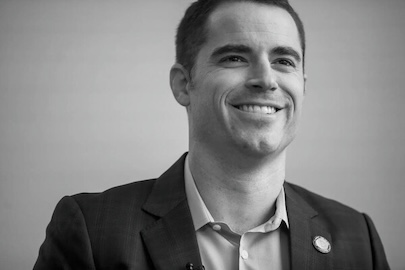
Contribution: Early investor, "Bitcoin Jesus," Bitcoin Cash advocate
Roger Ver is an early Bitcoin investor and promoter who became known as "Bitcoin Jesus" for his advocacy and funding of Bitcoin-related projects and businesses. He was an outspoken supporter of increasing Bitcoin's block size and, during the blocksize wars, backed alternative implementations and the hard fork that created Bitcoin Cash (BCH) in August 2017. His shift from promoting Bitcoin (BTC) to Bitcoin Cash made him a polarizing figure. Understanding his role is part of understanding the scaling debate, the philosophy of on-chain vs. Layer 2 scaling, and the fact that Bitcoin has no single leader: divergent views can lead to forks rather than forced changes to the main chain.
You ?

Contribution: The future of Bitcoin - Your story is still being written
Bitcoin's history is still being written. The network continues to evolve, and its future will be shaped by those who participate today. Developers contributing code, educators sharing knowledge, users running nodes, and builders creating on Bitcoin's foundation.
The pioneers on this page laid the groundwork, but Bitcoin's true potential will be realized by the collective efforts of its global community. Whether you're building infrastructure, creating applications, educating others, or simply using Bitcoin as peer-to-peer electronic cash, you are part of this ongoing experiment in decentralized money.
The question is not whether you can be a Bitcoin pioneer. It's what kind of pioneer you will choose to be.